You can watch every swing tutorial, take lessons from a PGA professional, and still struggle if your hands aren’t on the club correctly to begin with. The golf grip is your only point of contact with the club. Everything that happens through impact, from clubface angle, swing path, wrist hinge, to ball flight, everything is shaped by how those hands are positioned before you’ve even taken the club back. This guide covers how to grip a golf club the right way, walks you through all three grip types, and highlights the mistakes that quietly affect swings at every level.
Get Your Golf Grip Right: A Structured Technique
Before worrying about which grip style to use, it is essential that you get your hand placement fundamentals right. If you get the grip right, the swing has a chance. Get it wrong, and you’re facing consequences for the rest of the round. And if you have a golf simulator and know how golf simulators work, you can get the technique right with advanced analysis.
Here’s the step by step proper golf grip techniques for a golfer to get their golf grip correct:
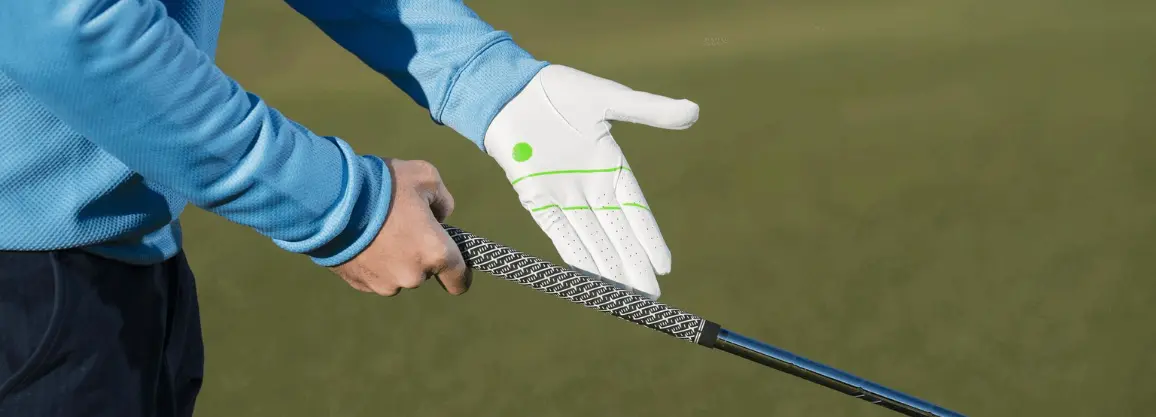
- Lead hand position: Place the club diagonally across the fingers of your left hand, from the base of the little finger to just below the middle joint of the index finger. The shaft should not run across the palm, as a palm grip kills wrist mobility & costs you clubhead speed.
- Close the lead hand: Wrap your fingers around the grip. When you look down, you should see two to three knuckles on the back of your left hand. Your left thumb should point just slightly right of center down the shaft.
- Check the V: The V formed between your left thumb and forefinger should point to the right shoulder for a right-handed golfer, and for a left-handed golfer, the V’s point to the left shoulder. This is the foundation of a correct golf grip.
- Trail hand placement: Bring the right hand in below the left. The grip runs diagonally through the fingers again, not the palm. The right palm should cover the left thumb almost entirely.
- Trail hand V: The V formed between your right thumb and forefinger should also point toward your right shoulder. Both Vs aligned is a reliable checkpoint for a proper golf grip.
- Connect the hands: Use one of the three grip styles below to link your hands together. Practicing these fundamentals consistently, using tools like residential golf simulator setups, can help build repeatable habits over time.
What are the Different Types of Golf Grips?
Once your hand placement is correct, your next decision is how to link them together. The best golf grip isn’t the same for everyone; each has a different feel, benefits, and golfers it suits best. There are three main golf hand grips; have a look at them & choose the one that best suits you.
The Ten-Finger Grip
The ten-finger grip is also referred to as the baseball grip. It is exactly what it sounds like: all ten fingers contact the club, with both hands sitting next to each other without any interlocking or overlapping. It’s the most natural starting point for beginners and the go-to golf grip position for golfers with smaller hands, shorter fingers, arthritis, or limited hand strength. It provides you with maximum wrist freedom, especially when practicing consistently on systems like Vision SP golf simulators that give immediate feedback.
How to Get a Ten-Finger Grip Right?
Place your left hand on the club with the grip in the fingers and your left thumb pointing down the shaft. Bring your right hand directly below, again with the grip in the fingers. Your right palm should cover the left thumb. Both hands sit flush against each other with no gap in this grip. And that’s it, this is just what you exactly need to do, all ten fingers on the club, both hands touching but not linked.
Mistakes to Avoid in a Ten-Finger Golf Grip
- Letting the hands drift apart creates a gap between the hands, leading to independent hand action and inconsistent clubface control.
- Gripping in the palms instead of the fingers, which locks the wrists and kills distance.
- Squeezing too tightly, the ten-finger grip already gives you a strong hold; excess pressure just creates tension.
- Allowing the trail hand to dominate, if the right hand takes over, you’ll get hooks and a closed face at impact.
The Overlapping Grip
The overlapping or Vardon grip is the most widely used grip on tour, and the one which most instructors teach first. In this, the trail hand’s little finger rests in the groove between the lead hand’s index and middle fingers rather than wrapping fully around the club. It’s the ideal golf grip for most adult golfers with average to large hands. It naturally reduces grip tension and promotes body rotation rather than hand manipulation, which can be further refined with advanced setups like Vision SP Plus for detailed swing feedback.
How to Get an Overlapping Grip Right?
Start with the ten-finger placement, then lift the little finger of your right hand and rest it softly in the groove between your left index finger and middle finger. Don’t force it; it should sit there naturally. Your right palm still covers the left thumb, and both Vs still point toward the right shoulder. This is the proper golf grip right hand position for the overlapping style.
Mistakes to Avoid in an Overlapping Golf Grip
- Losing the neutral hand position; both Vs should be checked regularly, especially after a break from play.
- Gripping too tightly with the trail hand, the right hand’s job is to guide, not to power the shot.
- Placing the club in the palm of the lead hand, the diagonal finger placement is non-negotiable for proper wrist hinge.
The Interlocking Grip
The interlocking grip in golf takes things one step further; the little finger of your trail hand doesn’t just rest on the lead hand, it fully locks between the lead hand’s index and middle fingers. It creates the most physically unified connection between the hands of any grip style, which is particularly valuable for golfers with smaller hands or shorter fingers who need that extra security. It can help control the clubface for golfers who struggle with an open face through impact, especially in structured practice with commercial golf simulators where consistency can be tracked over time.
How to Get an Interlocking Grip Right?
Place the lead hand on the club as normal. Then, instead of simply resting the thumb on the groove, slide it between the lead index and middle fingers, locking them together. The fingers should rest softly against each other, not pressing hard. The lead index finger curls around outside & both palms face each other. This is one of the most important golf grip tips for the interlocking style: keep the locked fingers relaxed, or it creates tension that travels up the forearms.
Mistakes to Avoid in an Interlocking Golf Grip
- Pressing the interlocked fingers together with force kills wrist mobility and adds unwanted forearm tension.
- Neglecting the V check, both Vs must still point toward the right shoulder for a good golf grip, regardless of style.
- Gripping too deeply with the lead index finger, which reduces control and feel in the fingers
What Golf Grip is Right for You?
If you have tried these golf grips, but you still remain a little confused as to which golf grip is actually right for you. Don’t worry, read below to have a clear idea of what grip is best for you as per your level. Also if you know how much does golf simulator costs and switch to an efficient simulator, it will let you know more precisely which one is right for you
Beginners & Junior Golfers
Start with the ten-finger grip. It’s the easiest to learn, feels the most natural, and lets you focus on the swing without battling an unfamiliar hand configuration. As strength and consistency develop, experimenting with the overlap is a natural next step. However, juniors with smaller hands may actually find the interlocking grip more comfortable and secure from the start.
Mid to Low Handicap Golfers
The overlapping grip is the industry standard for a reason. It balances control with wrist freedom and suits the majority of adult golfers with developed swing mechanics. If you’re working with a coach and playing regularly, this is almost certainly the best way to grip a golf club for your level.
Advanced & Competitive Golfers
At this level, it comes down to personal preference and what complements your ball-striking tendencies. Players who struggle with an open face may find the interlocking grip provides the control they need. Those who want maximum feel and wrist freedom lean toward the overlap. The key is consistency; whatever you choose, it should be the same grip every single shot.
Conclusion
Every shot you hit starts with your hands. A proper golf grip won’t fix every problem in your swing, but a poor one will create problems that no amount of swing work can overcome. Get the fingers right, check the Vs, choose the grip style that suits your hands and game, and keep the pressure consistent. It sounds simple because, in principle, it is. The key is making it repeatable, and that only happens through practicing for a while until it no longer feels like something to think about but rather a second nature.