We all know that most of our basements either sit half-finished, underused, or just keep housing boxes nobody opens & equipment nobody uses. But for golfers, this space carries something different; it is an opportunity to use that square footage for something they are passionate about. A basement golf simulator can give you year-round practice, real launch data on every shot, and the ability to play world-famous courses without leaving the house. And then winters, rain, bad weather, none of it matters. But getting the setup right requires more planning than most people realize. This guide covers everything from golf simulator ceiling height to equipment selection, step-by-step installation, and everything you must know before planning one.
Benefits of Installing a Basement Golf Simulator
If you are planning to get a golf simulator for basement, but are still confused whether it will be of any benefit or not, exploring residential golf simulator options can help you understand what works best for home environments. Here are some benefits you must know to have a clear idea of what golf basement ideas actually deliver. As a golf simulator in basement isn’t just a luxury add-on; it’s one of the most practical investments a serious golfer can make.
- Year-round access: No tee times, no weather cancellations, no seasonal gap that slowly undoes months of swing development. Thus, you get to practice when it suits you.
- Real-time shot data: An indoor golf simulator gives you data with every swing, producing ball speed, launch angle, spin rate, club path, and carry distance. That feedback loop turns practice from habit into measurable improvement.
- Controlled environment: Basements offer consistent lighting, temperature control, & natural soundproofing from the floors above, all of which improve screen visibility & enrich your overall experience.
- Private setup: With a golf simulator, you get no range crowds, no waiting, no distractions. Just you, your clubs, and whatever aspect of your game needs work that day.
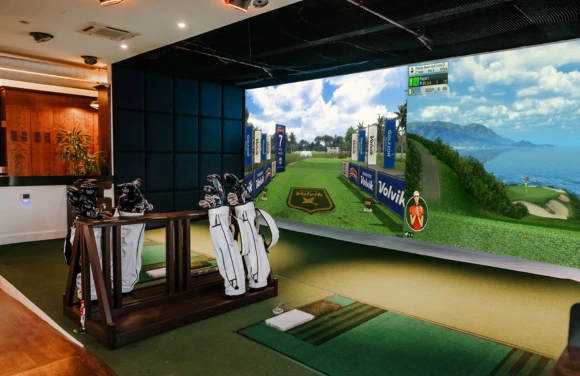
- Entertainment value: Golf simulators in the basement aren’t just great to practice, but they are equally great for enjoying with your friends as well. And due to this, a basement golf simulator room becomes one of the most-used spaces in the house.
Things to Get Right When Building Your Basement Golf Simulator
A basement golf simulator is a significant investment, and the most expensive mistakes in golf simulator basement builds occur even before a single piece of equipment is ordered. Thus, to help you get everything right, here are the eight elements that determine whether your basement golf setup delivers or disappoints.
Space & Room Size
The most important thing that you need to get right while building your basement golf simulator setup is to know how much space do you need for a golf simulator. Minimum workable dimensions for a basement golf simulator are 10-12 ft wide, 14-18 ft deep, and 9-10 ft high for comfortable full driver swings. So, before ordering anything, take a slow practice swing with your driver at the exact hitting spot, mark where the club reaches, then add 6–9 inches of clearance above that mark. Even a perfect setup won’t work if your swing feels restricted, so get it right.
Projector & Visual Alignment
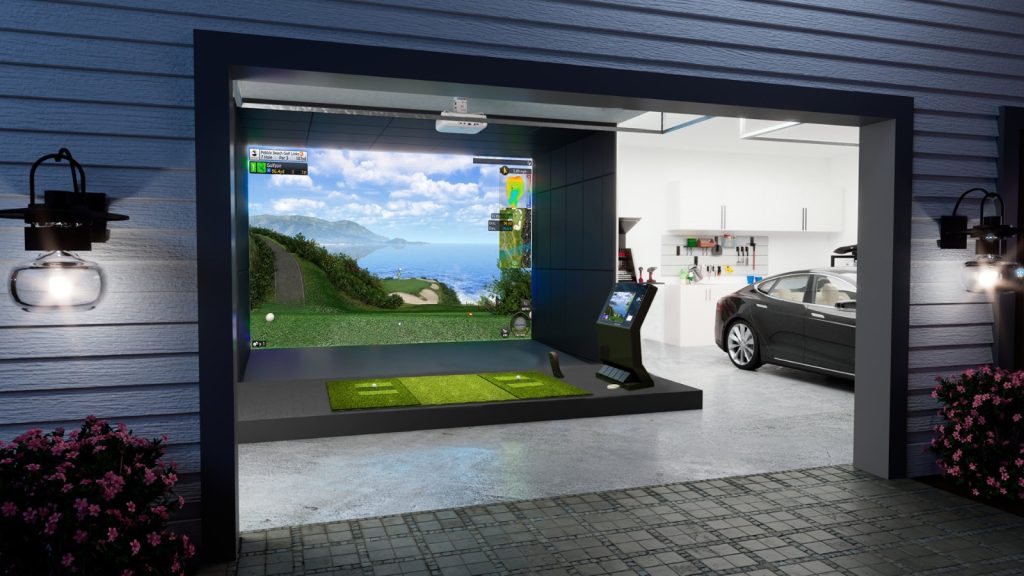
Getting your projector well-aligned makes your simulator feel realistic and immersive. A short-throw projector is essential in a basement to avoid shadows, as it projects a large image from a short distance and stays out of your swing path. Mount it to the ceiling above the hitting area and calibrate the image to fill the screen completely. Misaligned projection is one of the most common post-installation complaints and one of the easiest to prevent with careful planning upfront.
Hitting Surface & Mat Quality
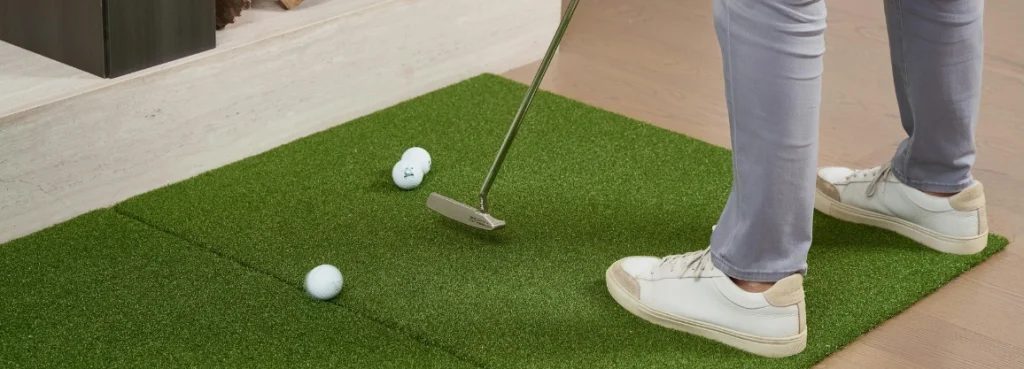
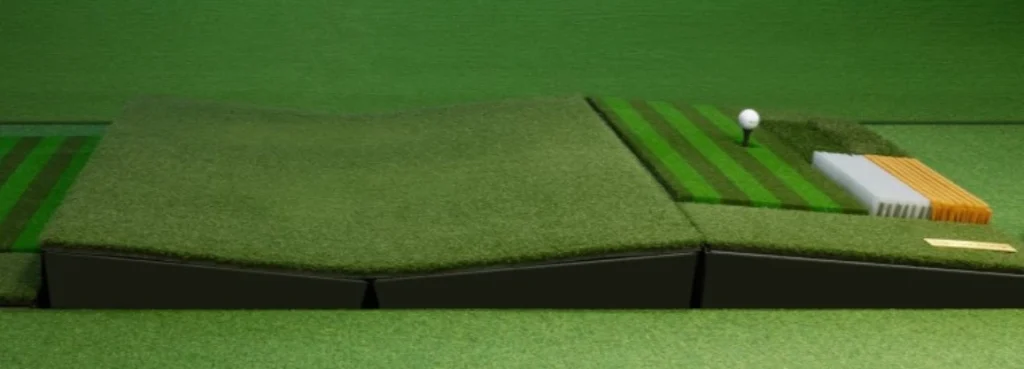
Your mat directly impacts both performance & injury risk; thus, getting it right is more essential than you might think. A thin, cheap mat on a concrete floor is a wrist and elbow injury waiting to happen. Hence, a multi-layer commercial mat with a replaceable hitting strip & shock absorption is the right choice. Remember that a mat adds 1–2 inches of height, so account for this in your ceiling clearance calculations before installation. A cheap mat may save money initially, but it can lead to poor habits and physical strain.
Launch Monitor
This is the brain of the entire system. For golf simulator basement setups, camera-based units are almost always superior to radar units; they don’t require as much depth behind the golfer and perform better in low-light conditions. Don’t cut the budget here; as inaccurate data actively hurts improvement. Golf simulators like Golfzon Vision SP are a great choice as they offer you professional accuracy and are built to fit your basement perfectly.
Impact Screen & Safety Setup
Your impact screen needs to handle full driver strikes without tearing, display a crisp projected image, and be mounted with at least 1 ft of clearance behind it to safely absorb ball impact. Thus, side netting is non-negotiable, as heel strikes and off-angle shots will find any gap you leave. For more advanced, high-durability setups, exploring commercial golf simulator solutions can give you a better understanding of build quality & enclosure standards. So budget accordingly, as a proper safety setup protects your walls, equipment, and most importantly, you.
Software
The software platform determines the course library, data display quality, and overall simulation experience. Thus, getting it right is necessary; so look for software with features like real-course play, practice modes, & swing analysis, for instance, golf simulators like Golfzon Vision SP Plus. Choose software that’s compatible with your launch monitor before you buy either one. Good software is key to keeping your practice engaging & structured over time, so get it right.
Lighting & Soundproofing
Overhead fluorescent lights cause glare on impact screens and can interfere with camera-based launch monitor tracking. So use soft, diffused LED strips positioned away from the screen face. For soundproofing, acoustic panels, rubber flooring underlayment, and mass-loaded vinyl on shared walls all significantly reduce impact noise, which is especially important if the basement is beneath a bedroom or living area.
Budget Planning & Future Upgradation
As much as it is important to get a golf simulator right, even more important is to know how much does a home golf simulator costs. As an entry-level basement build, a mid-tier setup, and a premium build with 4K projection, tour-level tracking, and full-room finishing all vary significantly in cost. Thus, knowing your goal & requirements will let you get the right golf simulators in your budget, and plan for hidden costs & potential floor excavation if lowering basement floor for golf simulator clearance is needed. Build the infrastructure right first and upgrade components over time.
How to Install Your Basement Golf Simulator?
A golf simulator basement setup goes smoothly when you work through it in sequence. Skipping steps, especially the space assessment, is how expensive mistakes happen. Thus, here is your comprehensive guide on how to install a basement golf simulator perfectly. Also, if you’re new to this technology, understanding how golf simulators work will give you a clearer picture of what each component is actually doing.
- Measure everything first: Record the basement golf simulator ceiling height, room width, and depth. Take a slow driver swing in the exact hitting spot and mark the highest point the club reaches.
- Design the room layout: Map out hitting position, screen placement, projector location, and side clearance on paper before touching anything.
- Handle electricals and ventilation: Projectors generate heat. A dedicated circuit for simulator equipment avoids tripped breakers, and proper ventilation prevents overheating.
- Build or install the enclosure: Mount the impact screen frame, install the screen with 1 ft rear clearance, and add side netting for full containment & anchor everything securely.
- Mount the projector: Ceiling-mount centered above the hitting position. Confirm the throw distance matches the screen size before drilling. Calibrate the image to fill the screen without distortion.
- Position the launch monitor: Camera-based units sit beside the hitting mat per manufacturer specs. Radar units go behind the golfer. Keep at least 10–12 ft between ball and screen for accurate data capture.
- Lay the hitting mat: Position centered in the hitting zone. Add anti-fatigue matting around it for extended practice sessions on concrete.
- Test, calibrate, and fine-tune: Hit shots across all clubs and compare data against expected benchmarks. Adjust projector alignment, mat position, and monitor angle until everything reads cleanly.
Is a Golf Simulator in Your Basement Worth It?
For a golfer who plays regularly, keeps thinking about basement golf simulator ideas, and cares about improving, a big yes, without much debate. The combination of year-round access, real-time data on every shot, and the ability to play famous courses on your own schedule makes a basement golf setup one of the highest-return home improvements a golfer can make. The upfront investment is real, but spread across years of use, the cost per session is far lower than regular range visits or tee times. What makes it genuinely worth it isn’t the technology itself; it’s the consistency of practice that the technology makes possible. Thus, if you are passionate about golf, an indoor golf simulator for the basement is completely worth it for you.
Conclusion
A golf simulator in basement is one of the most rewarding projects a golfer can undertake, and far more achievable than most people assume. Measure first, get the ceiling height right, prioritize the launch monitor and mat, and build toward the vision rather than trying to achieve everything at once. Your basement already has everything it needs to become your best practice tool; it just needs the plan. So plan, practice & enjoy whenever you want.