Short answer: A golf simulator business is an indoor venue that rents simulator bays by the hour, often with food, drinks, lessons, leagues and events. To start one, choose a business model, research your local market, plan about 800 sq ft per simulator in a space with 10 to 11 ft ceilings, and check zoning, parking, plumbing, liquor licensing and noise before you sign a lease. Most openings take 3 to 6 months. Whether you call it an indoor golf business or a virtual golf business, the planning steps below are the same. |
Golf participation is growing, and off-course golf is growing even faster. That makes a commercial golf simulator venue one of the most compelling experience-based businesses you can open today. This guide walks through what it really takes – market trends, location and zoning, space planning, business models, and technology selection.
Key takeaways
- Choose your business model first. It determines your ideal customer, location and layout.
- Plan on roughly 800 sq ft per simulator for a complete facility (400 sq ft per bay plus shared space).
- Each bay needs a 10 to 11 ft ceiling height.
- Use a commercial realtor and expect the search-to-opening process to take 3 to 6 months.
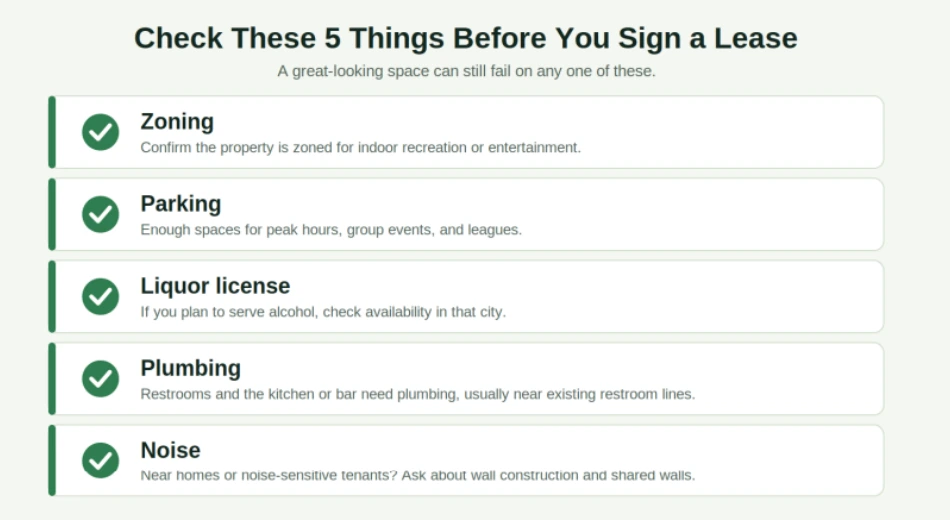
- Check zoning, parking, plumbing, liquor license availability and noise before you sign a lease.
Why the Commercial Golf Simulator Market Is Growing
The U.S. golf participant base now approaches 50 million people, and the audience extends well beyond traditional golfers to casual players, corporate groups, families, and beginners. Modern consumers increasingly value memorable experiences, and simulator venues combine athletic activity, food and beverage, and social interaction in one destination – rather than depending on merchandise sales alone.
The National Golf Foundation counted 48.1 million U.S. golfers in 2025, an all-time high that includes on-course play and off-course play such as simulators, ranges and entertainment venues. Its 2025 simulator research also found that 51% of simulator users had not played on a golf course in the previous 12 months. Indoor golf is reaching people that traditional courses do not.
What Makes a Golf Simulator Venue a Strong Business
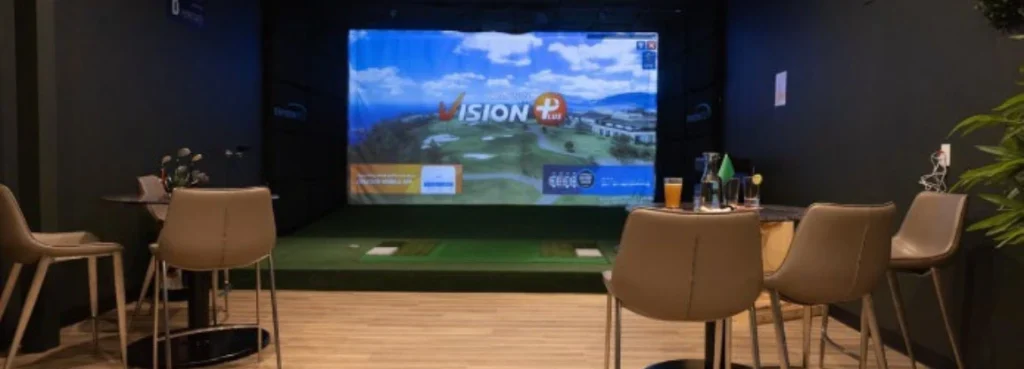
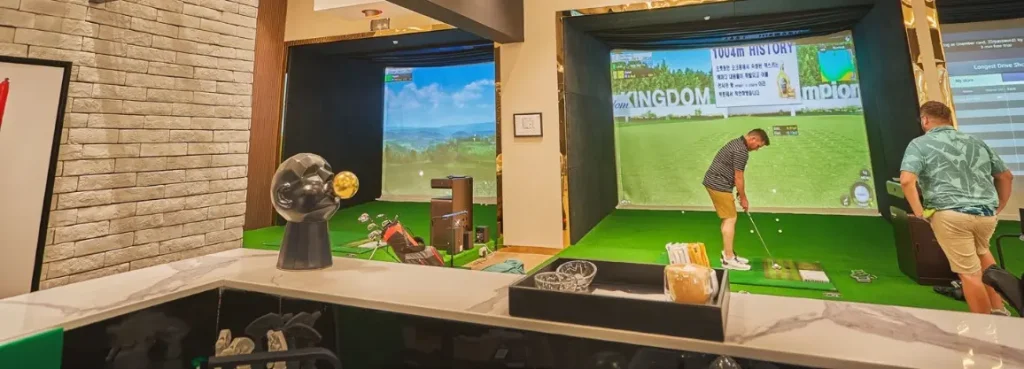
Successful venues function as hospitality-driven experience spaces, not simple hitting facilities. A welcoming atmosphere with seating, refreshments, and light food encourages longer stays and repeat visits. Value comes from the experience itself – hourly bay rentals, lessons, leagues, events, food service, corporate bookings, and memberships.
Is A Golf Simulator Business Profitable?
A golf simulator business can be profitable, but the result depends on four things: how many hours your bays are booked, your hourly rate, what you earn from food, drinks, lessons and events, and your rent. Location influences all four, because a site with steady traffic and the right customer mix fills bays more often.
Monthly bay revenue = number of bays x open hours per month x utilization x hourly rate
Illustrative example, not a projection: 6 bays x 300 open hours x 30% utilization x $40 per hour = $21,600 per month in bay revenue, before food, drinks, lessons and events. Subtract rent, labor, insurance and other costs to find your break-even point. GOLFZON systems from GTB carry no online service fees, which removes one recurring cost from the model. Track your indoor golf simulator business revenue by stream (bays, food and drinks, lessons, events) so you can see which one carries the business.
What Business Model Should You Choose For Your Golf Simulator Business?
Before you search for a location, decide what kind of business you are building. Your model determines your target customer, and your target customer determines where you should be. Choosing your golf simulator business model first also makes the business plan and budget easier to build.
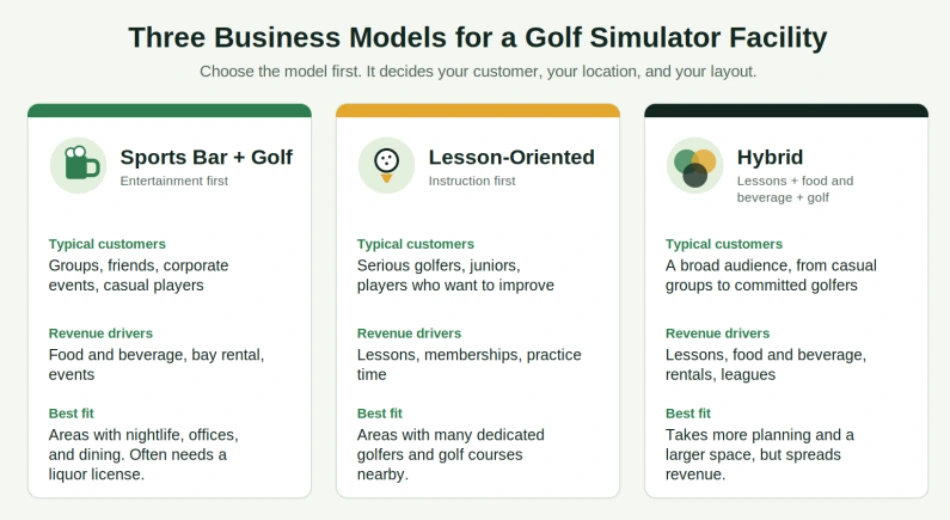
Model | Focus | Typical customer | Revenue drivers |
|---|---|---|---|
Sports bar + golf | Entertainment and social experience | Groups, friends, corporate events, casual players | Food and beverage, bay rental, events |
Lesson – oriented | Instruction and practice | Serious golfers, juniors, improvers | Lessons, memberships, practice time |
Hybrid | Lessons, food and beverage, and golf | Broad audience, from casual groups to committed golfers | Lessons, food and beverage, rentals, leagues |
Sports bar + golf. A social venue where golf is the entertainment. It does best near nightlife, offices and dining, and it often needs a liquor license. Many operators run this format as a golf simulator lounge.
Lesson-oriented. A training facility built around instruction and performance. It fits areas with many dedicated golfers and golf courses nearby.
Hybrid. Combines lessons, food and beverage, and recreational play. It reaches the widest audience and spreads revenue across several streams, though it takes more planning and a larger space.
Start by asking who your target customers are. Are they casual groups looking for a night out, committed golfers working on their game, or both? Your answer shapes every decision that follows.
Location, Zoning, and Parking
Site selection matters more than almost anything else. Evaluate who your likely customer is through local demographics — golfer population, income, age, and recreation culture. Proximity to anchors like sporting-goods retailers, golf courses, and active retail corridors reduces the need to educate customers. Before you lease, verify:
- Indoor sports / recreation allowance
- Food & beverage and alcohol service permissions
- Parking requirements and signage limits
- Operating-hour, noise, and occupancy considerations
- Ceiling height and structural specifications
How Do You Research Your Market?
Base your decision on market research tied to your customers and business model, not just on what looks like a good retail space. Review these five factors around each site:
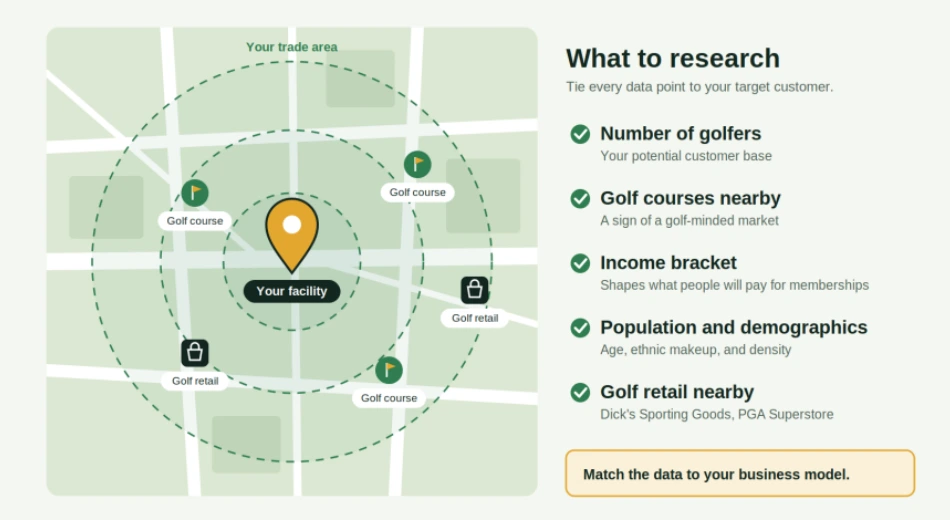
- Number of golfers in the area. More active golfers means a bigger potential customer base.
- Number of golf courses nearby. Golf-heavy markets support lesson-oriented and hybrid models. In cold climates, golfers also want an off-season option.
- Income bracket. Household income affects willingness to pay for memberships, lessons and premium experiences.
- Population and demographics. Look at age, ethnic makeup and population density. Different communities have different golf and entertainment preferences.
- Nearby golf-related retail. Stores like Dick’s Sporting Goods or PGA Superstore, and golf courses, signal an existing golf-minded audience.
Practical tip: match the data to your model. A sports bar concept needs population density plus dining and nightlife traffic. A lesson-based facility needs a concentration of dedicated golfers and courses.
What Else Should You Check Before You Sign A Lease?
Add plumbing to the checklist above. Restrooms and a kitchen or bar need plumbing, and it is usually cheapest to build near existing restroom lines. If the space is near homes or other noise-sensitive tenants, also ask about wall construction and shared walls.
How Do You Find The Right Facility?
- Work with a large commercial real estate firm. Choose one with a strong commercial department. It has broader access to listings and more experience negotiating leases.
- Confirm signage rights. Your sign is your storefront. Check where signage can go and whether window decals are allowed.
- Plan your timeline. From search to opening, the process typically takes 3 to 6 months.
How Many Simulators Do You Need, And How Much Space?
One simulator bay often takes about 400 square feet including hitting and customer areas. A 10-bay facility needs roughly 4,000 square feet for bays alone – but a complete venue needs about twice the bay area for reception, restrooms, storage, kitchen, and waiting space, typically 8,000 to 10,000 square feet total.
As a planning rule, budget about 800 sq ft per simulator for the whole facility, with each bay at 400 sq ft and a 10 to 11 ft ceiling. For reference, the GOLFZON Vision SP Plus lists a minimum installation footprint of 13.2 ft wide by 21.5 ft deep for a standard bay, or 15 ft by 21.5 ft for a both-hand bay, with a 10 ft ceiling. Planning around 400 sq ft per bay leaves room for seating and walking space. Treat these golf simulator bay dimensions as the minimum when you measure a space.
How many simulator bays should you install? Start with the number your market and budget can support, then use the table below to check the total space you need. If you are unsure, plan the layout so more bays can be added later.
Number of simulators | Approx. total facility space |
|---|---|
2 | ~1,600 sq ft |
4 | ~3,200 sq ft |
6 | ~4,800 sq ft |
8 | ~6,400 sq ft |
10 | ~8,000 to 10,000 sq ft |
These estimates assume a rectangular space with no interior columns. Columns, irregular shapes or a large kitchen increase the space you need.
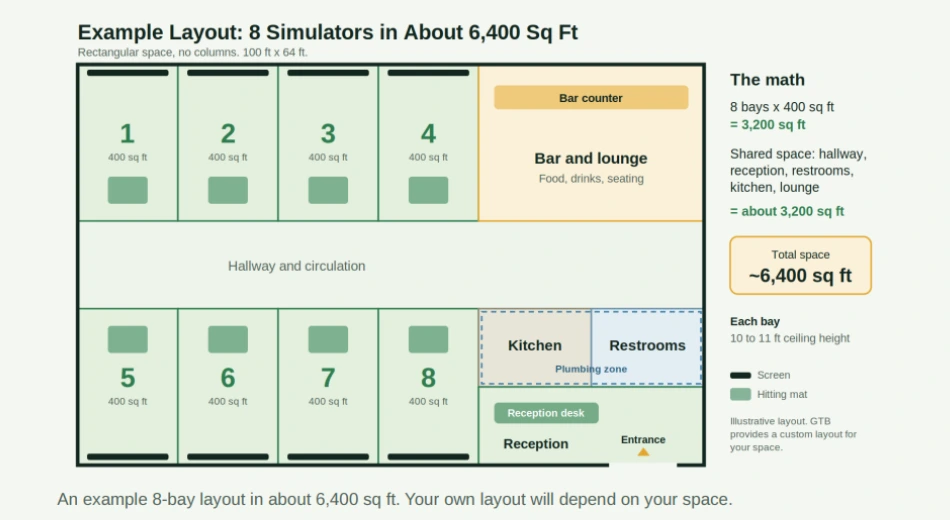
Example layout: 8 simulators in about 6,400 sq ft (100 ft x 64 ft, no columns). Four bays run along the top wall beside a bar and lounge. A hallway runs between the two rows. Four more bays sit along the bottom wall next to the kitchen, restrooms (which share a plumbing zone), reception desk and entrance. The math: 8 bays x 400 sq ft = 3,200 sq ft, plus about 3,200 sq ft of shared space = about 6,400 sq ft.
GTB provides your first system layout and 3D rendering for free. That helps you plan bay placement, traffic flow and common areas before you commit to a space.
Choosing the Right Technology
Technology should match the business goal. Golfzon Vision SP suits operators who want a compact, efficient commercial system with strong realism at a lower entry cost. Golfzon Vision SP Plus targets premium venues that need a higher-end experience – auto tee-up and a moving swing plate – to justify elevated pricing and improve retention.
The best commercial golf simulator for your venue is the one that fits your business model, room size and budget. When you compare the best golf simulator for business use, look at durability for all-day play, multiplayer and league features, ongoing software fees, and local installation and support.
Feature | Vision SP | Vision SP Plus |
|---|---|---|
Best for | Smaller rooms and budget-conscious operators | Premium, immersive venues |
Sensor | Accurate camera tracking | Dual-camera T2 sensor |
Tee-up | Manual | Auto tee system |
Swing plate | Fixed | 8-direction moving plate |
Projection | Standard | 5,300 lumens |
Installation | Simple enclosure | Full booth construction |
Courses | 300+ world-famous courses | 300+ world-famous courses |
Why Operators Choose Golfzon Vision Sp Plus For Commercial Use
- Built for continuous play. Designed for durability and 24/7 operation, with dual-camera T2 sensors for club and ball data.
- No online service fees. GTB provides full online service without charging online service fees, which helps a business reach profitability sooner.
- Proven at scale. More than 1,900 locations worldwide use the Vision SP Plus, with 300+ courses included.
- Full launch support. From finding a location to layouts and 3D renderings, plus installation, staff training, and after-sales support.
What Makes A Golf Simulator Commercial Grade?
A commercial grade golf simulator is built for all-day use by many different players. Compared with a home unit, it needs durable sensors and hardware, a software license that allows business use, multiplayer and league modes, and dependable installation and support. That is the difference between a simulator you own and one you can run as a business.
How Much Does A Commercial Golf Simulator Cost?
The price of a commercial indoor golf simulator is only one part of what it costs to open. Plan your golf simulator business startup costs in three parts:
Cost area | What it includes | What drives it |
|---|---|---|
Simulators | Hardware, software, screens, hitting mats, installation, staff training | Number of bays, model, bay type |
Space | Lease or purchase, build-out, ceiling and wall work, plumbing, signage | Square footage, city, condition of the space |
Operations | Licenses, insurance, staffing, booking software, marketing, bar and kitchen supplies | Business model, liquor service, hours |
GTB lists its all-in GOLFZON package starting at $24,950, with no online service fees or subscriptions and a finance program available. Industry guides commonly cite $22,000 to $85,000 for a complete commercial simulator setup, and $50,000 to $250,000 in total startup cost for a small venue with 2 to 4 bays. For a price based on your bay count and layout, request a quote from GTB.
If you are comparing financing or commercial golf simulator lease options, add the monthly payment to your operating costs before you run the break-even math above.
How Does Commercial Golf Simulator Installation Work?
Every commercial golf simulator build is different, but most follow the same order: plan the layout, prepare the room, then install the commercial golf simulator enclosure or booth, the hardware and the software.
Installation is planned around your space and the model you choose. The Vision SP uses a simple enclosure. The Vision SP Plus uses full booth construction. A typical process with GTB looks like this:
- Share your floor plan or square footage with GTB.
- Review your free first layout and 3D rendering, then adjust bay placement and traffic flow.
- Confirm ceiling height, room dimensions and any plumbing or build-out work for the rest of the venue.
- Install the enclosure or booth, simulator hardware and software.
- Calibrate the system and train your staff.
- Get after-sales support as you open and operate.
Why Short Game and Hospitality Drive Repeat Visits
Commercial success requires satisfying short game, chipping, and putting – not just acceptable long-game data. When full rounds aren’t enjoyable, guests stop coming back; superior short-game simulation fuels competitive league play and higher traffic. Pair that with simple hospitality – beer and wine, hot snacks, group menus, coffee – and one-time visits become repeat group bookings.
How To Run A Golf Simulator Business Day To Day
Keep bays booked and the experience consistent. Use online booking software so guests can reserve bays, set peak and off-peak rates, fill slower nights with leagues and corporate events, and train staff to reset bays and help first-time players. Maintenance is light: mostly screens, mats and tees, plus daily cleaning.
What Goes in a Golf Simulator Business Plan?
A golf simulator business plan should cover eight areas:
- Business model and concept
- Target customers and local market data
- Bay count, space needs and layout
- Startup costs and financing
- Pricing, utilization and revenue forecast
- Staffing and operations
- Marketing and event strategy
- Licenses, insurance and launch timeline
For an indoor golf simulator business plan, add your lease terms and a break-even estimate based on bay utilization. You can use the eight areas above as a simple golf simulator business plan template.
How GTB Entertainment Supports You
GTB Entertainment provides complimentary commercial consulting covering location selection, system layout, store and kitchen design, menu planning, bay-count optimization, and installation guidance – supporting operators through the entire planning process.
Plan your facility with GTB Entertainment
GTB Entertainment is an authorized GOLFZON dealer headquartered at 940 N. Central Ave, Wood Dale, IL. We help commercial owners with system selection, layout design, and launch planning. See our commercial golf simulators, the GOLFZON Vision SP Plus, or request a free consultation.
In a Nutshell
Commercial golf simulators align with multiple market trends: expanding golf participation, growing off-course play, and rising demand for social, experiential entertainment. Choose your market, location, space, and technology strategically and your venue becomes a destination for practice, events, hospitality, and recurring traffic. Contact us to start your plan.